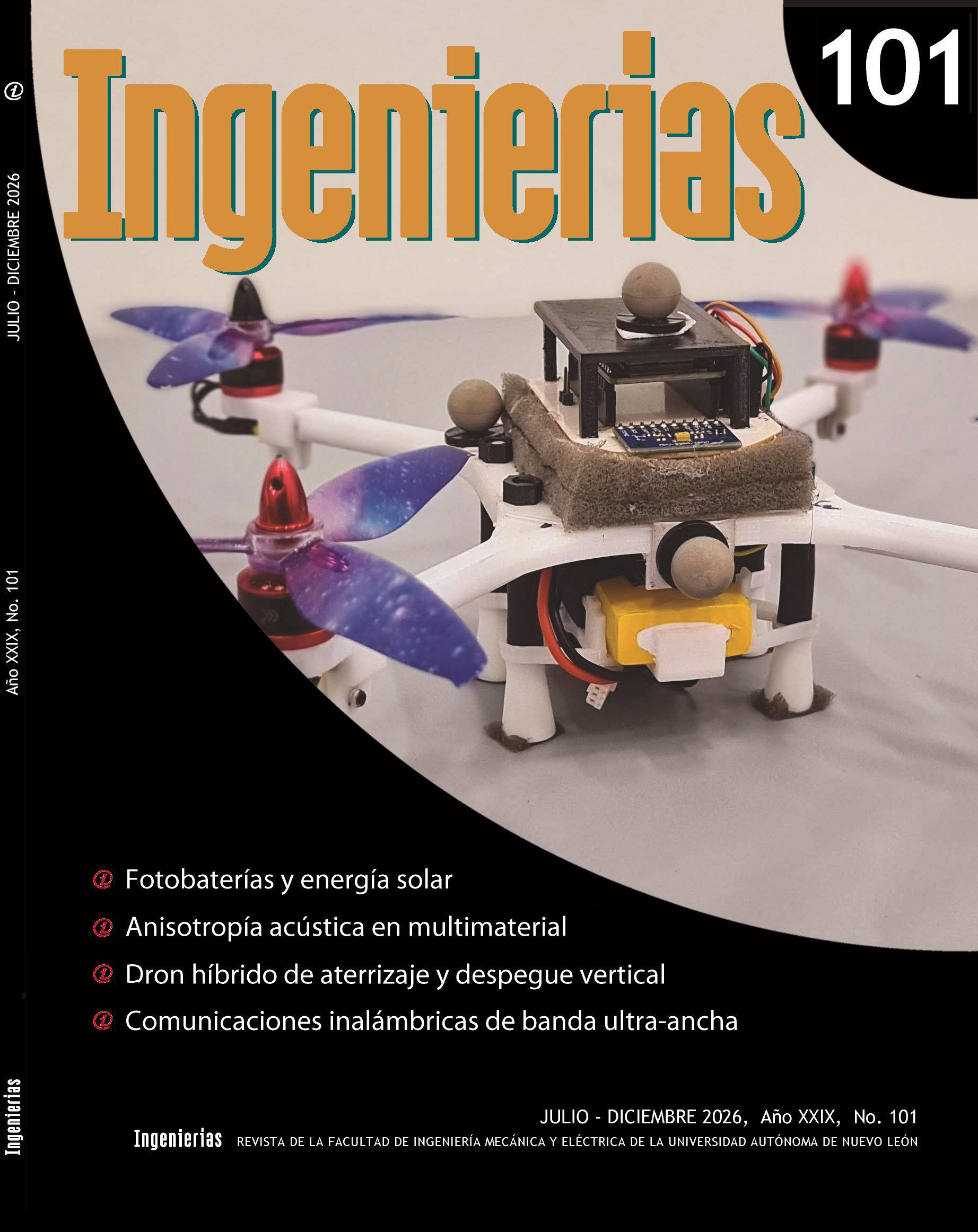
Study of a hybrid drone with vertical take-off and landing capabilities for volcanic monitoring
DOI:
https://doi.org/10.29105/ingenierias29.101-1005Keywords:
UAV, VTOL, volcanic monitoring, CFD simulation, structural analysisAbstract
The use of drones for monitoring and disaster prevention has grown significantly in recent years. This work presents the modeling and numerical analysis of an UAV designed for volcanic monitoring. Its aerodynamic performance was evaluated through numerical simulations, obtaining pressure fields applied in the structural analysis. Different materials were analyzed to optimize the strength-to-weight ratio, concluding that the drone exhibits adequate structural behavior for this application.
Downloads
References
1. Gómez-Castillo, G. (2017). Riesgo volcánico: Estado del arte y desafíos de trabajo. Revista Geográfica, 158, 69–106.
2. Altamirano-Santillán, E. V., Vallejo-Vallejo, G. E., & Cruz-Hurtado, J. C. (2017). Monitoreo volcánico usando plataformas Arduino y Simulink. Revista de Investigación, Desarrollo e Innovación, 7(2), 317–329. https://doi.org/10.19053/20278306.v7.n2.2017.6073. DOI: https://doi.org/10.19053/20278306.v7.n2.2017.6073
3. Karachalios, T., & Orphanoudakis, T. (2025). Autonomous UAV-based volcanic gas monitoring: A simulation-validated case study in Santorini. Drones, 9(12), 829. https://doi.org/10.3390/drones9120829. DOI: https://doi.org/10.3390/drones9120829
4. Wang, Y., Lei, P., Lv, B., Li, Y., & Guo, H. (2023). Study on fluid–structure interaction of a camber morphing wing. Vibration, 6(4), 1060-1074. https://doi.org/10.3390/vibration6040062. DOI: https://doi.org/10.3390/vibration6040062
5. Hou, G., Wang, J., & Layton, A. (2012). Numerical methods for fluid–structure interaction. Communications in Computational Physics, 12 (2) 337-377 https://doi.org/10.4208/cicp.291210.290411s. DOI: https://doi.org/10.4208/cicp.291210.290411s
6. Liu, X., Abà, A., Capone, P., Manfriani, L., & Fu, Y. (2022). Atmospheric disturbance modelling for a piloted flight simulation study of airplane safety envelope over complex terrain. Aerospace, 9(2), 103. https://doi.org/10.3390/aerospace9020103. DOI: https://doi.org/10.3390/aerospace9020103
7. Martins, J. R. R. A., Kennedy, G. J., & Kenway, G. K. W. (2014). High aspect ratio wing design: Optimal aerostructural tradeoffs for the next generation of materials. En 52nd Aerospace Sciences Meeting (AIAA 2014-0596). American Institute of Aeronautics and Astronautics. https://doi.org/10.2514/6.2014-0596. DOI: https://doi.org/10.2514/6.2014-0596
8. Castillo, A., Tenicota, A., & Nuela, S. (2020). Comportamiento aerodinámico en la reducción del arrastre mediante la variación de accesorios en un tractocamión. 3C Tecnología: Glosas de innovación aplicadas a la pyme, 9(4), 17–43. https://doi.org/10.17993/3ctecno/2020.v9n4e36.17-43. DOI: https://doi.org/10.17993/3ctecno/2020.v9n4e36.17-43
Downloads
Published
How to Cite
Issue
Section
License
Copyright (c) 2026 Ing. Santiago Alemán, Dr. Octavio García Salazar, Dr. Luis Arturo Reyes Osorio, M.C. Diego Reducindo Almanza, Dr. Eduardo Steed Espinoza Quesada

This work is licensed under a Creative Commons Attribution 4.0 International License.