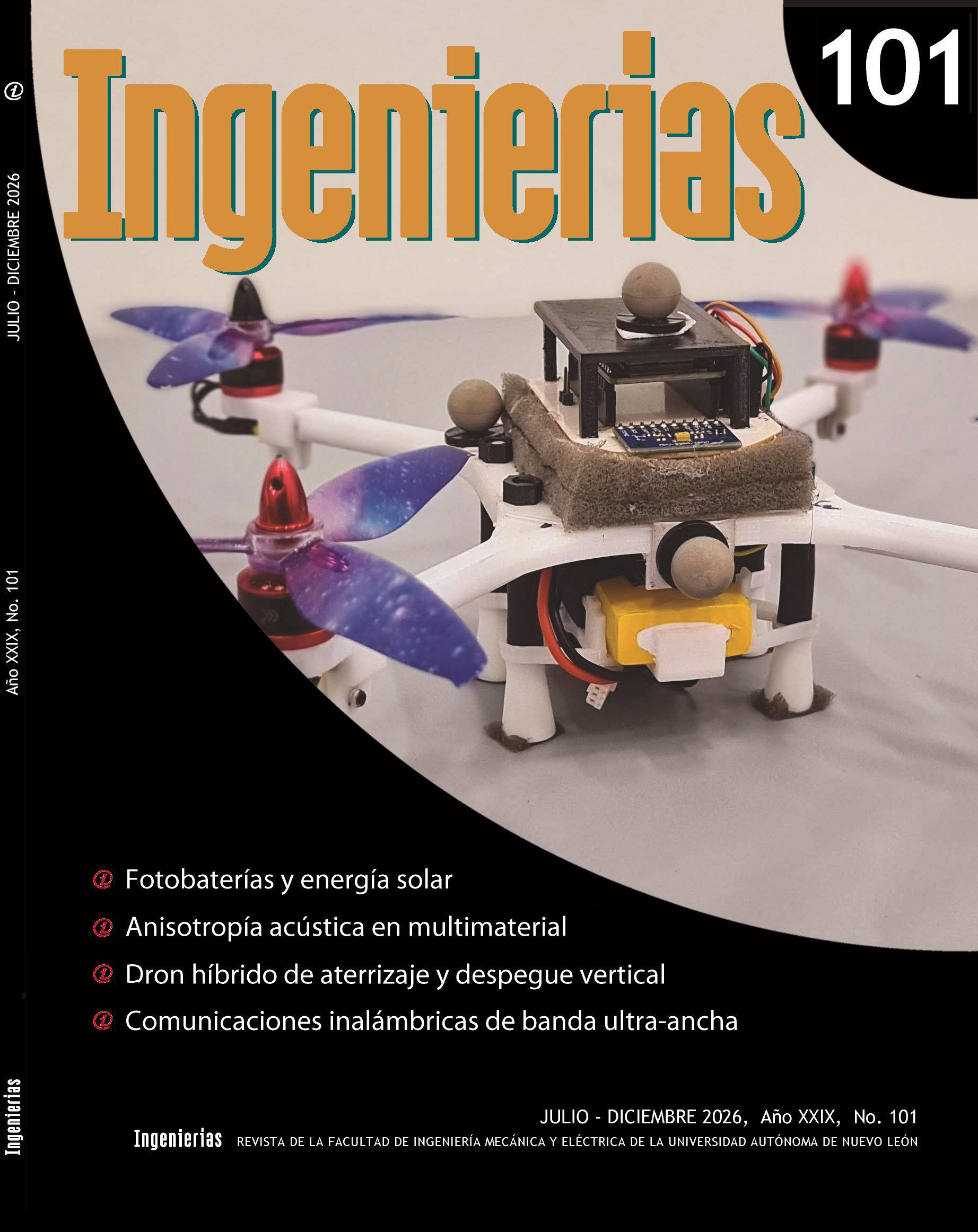
Validation of a 3D-printed quadrotor: structure, model, and parameters
DOI:
https://doi.org/10.29105/ingenierias29.101-1009Keywords:
Quadrotor, 3D-printing, structural analysis, mathematical model, parameter estimationAbstract
In recent years, 3D-printing has become popular for creating polymer structural components, such as quadrotor frames. On the other hand, mathematical modelling of unmanned aerial vehicles with the help of intelligent algorithms has also been a topic of study at present. However, few contributions with experimental data have been carried out to validate the structure, mathematical model and parameters of a 3D-printed quadrotor. Therefore, the objective of this work is to present a methodology to experimentally validate the structure of a 3D-printed quadrotor frame, its mathematical model and parameters using neural networks. Results show appropriate performance of the quadrotor for flight condition.
Downloads
References
1. Fernando, H. C. T. E., De Silva, A. T. A., De Zoysa, M. D. C., Dilshan, K. A. D. C., & Munasinghe, S. R. (2013, December). Modelling, simulation and implementation of a quadrotor UAV. In 2013 IEEE 8th International conference on industrial and information systems (pp. 207-212). IEEE. DOI: https://doi.org/10.1109/ICIInfS.2013.6731982
2. Singh, R., Kumar, R., Mishra, A., & Agarwal, A. (2020). Structural analysis of quadcopter frame. Materials Today: Proceedings, 22, 3320-3329. DOI: https://doi.org/10.1016/j.matpr.2020.03.295
3. MathWorks. Mathematical Modeling. Available on www.mathworks.com/solutions/mathematical-modeling.html. 2024.
4. Legowo, A., Sulaeman, E., & Rosli, D. (2019, March). Review on system identification for quadrotor unmanned aerial vehicle (UAV). In 2019 Advances in Science and Engineering Technology International Conferences (ASET) (pp. 1-8). IEEE. DOI: https://doi.org/10.1109/ICASET.2019.8714531
5. Tan, K. C., & Li, Y. (1997). Evolutionary system identification in the time domain. Proceedings of the Institution of Mechanical Engineers, Part I: Journal of Systems and Control Engineering, 211(5), 319-323. DOI: https://doi.org/10.1243/0959651971539849
6. Ollervides-Vazquez, E. J., Rojo-Rodriguez, E. G., Rojo-Rodriguez, E. U., Cabriales-Ramirez, L. E., & Garcia-Salazar, O. (2020, November). Two-layer saturated PID controller for the trajectory tracking of a quadrotor UAV. In 2020 International Conference on Mechatronics, Electronics and Automotive Engineering (ICMEAE) (pp. 85-91). IEEE. DOI: https://doi.org/10.1109/ICMEAE51770.2020.00022
7. Tagay, A., Omar, A., & Ali, M. H. (2021). Development of control algorithm for a quadcopter. Procedia Computer Science, 179, 242-251. DOI: https://doi.org/10.1016/j.procs.2021.01.003
8. Yedavalli, R. K. (2020). Flight dynamics and control of aero and space vehicles. John Wiley & Sons.
Downloads
Published
How to Cite
Issue
Section
License
Copyright (c) 2026 Alejandro Jimenez Flores, Pablo Alfonso Tellez Belkotosky, Edmundo Javier Ollervides Vazquez, Luis Arturo Reyes Osorio, Octavio Garcia Salazar

This work is licensed under a Creative Commons Attribution 4.0 International License.
Funding data
-
Office of Naval Research Global
Grant numbers N629092512014